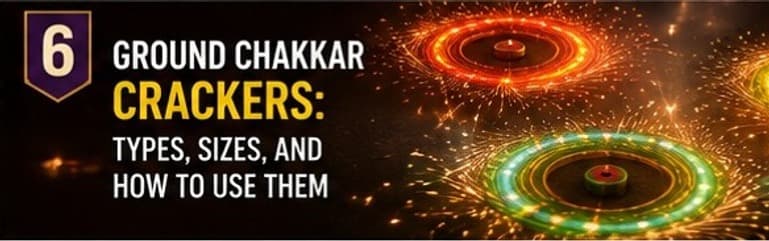
Ground Chakkar Crackers: Types, Sizes, and How to Use Them
The chakkar is one of the most exciting ground-based crackers — a spinning wheel of sparks that whirls at high speed. Learn the types available and the right way to set them up safely.
What Is a Chakkar?
The chakkar — also called a ground spinner, Catherine wheel, or ground chakkar — is a firework that rotates rapidly when lit, producing a spinning wheel of sparks and coloured flames. It is a ground-level cracker that stays in one place while it spins, driven by the directional thrust of burning composition.
Chakkars are among the most visually distinctive fireworks in the Indian cracker catalogue. The spinning effect creates trails of light in a circle or spiral, and the sound — a rapid sizzle building to a roar — adds to the excitement. They are especially popular with children and young adults who enjoy watching the spinning motion.
Types of Chakkars
The chakkar market offers several variations:
- Standard single-layer chakkar — A flat, disc-shaped firework that spins on the ground. Produces silver or gold sparks. Burn duration typically 20–40 seconds.
- Colour chakkar — Spins with coloured flame output (red, green, or blue). Slightly shorter burn duration due to the chemical composition.
- Rising chakkar — A speciality type that begins spinning on the ground and then lifts into the air as the spin accelerates. Requires careful placement and more open space.
- Multi-tier chakkar — Two or three layers that spin in alternating directions, creating a layered spiral effect. Popular for display events.
- Musical chakkar — Produces a whistling tone as it spins, in addition to visual effects.
How to Set Up a Chakkar
The way you set up a chakkar determines whether it spins freely or wobbles dangerously. Incorrect setup is the most common cause of chakkar-related accidents.
Nail or pin method (most common)
Hammer a small nail into a wooden board so that a short section protrudes. Place the chakkar's central hole over the nail and confirm it can rotate freely. The nail head should be no larger than the chakkar hole — too large, and the chakkar binds instead of spinning.
Alternative: ground pin
Some chakkars come with a spike at the centre. Press this spike into soft, packed soil so the chakkar sits at ground level and can rotate freely.
Never place a chakkar flat on a rough or uneven surface without a central pin — it will wobble, travel unpredictably, and potentially move toward bystanders.
Safe Distance and Placement
Stand at least 3 metres away once a chakkar is lit. If using the rising variety, ensure at least 10 metres of clear space above and around. Never position a chakkar pointing toward people, cars, or dry vegetation.
Before lighting, clear any dry leaves or debris from a 1-metre radius around the chakkar. Sparks can travel outward at low angles during the spin.
Lighting the Chakkar
Use a long-handled lighter or a lit agarbatti to ignite the fuse. Light it from the side, not by reaching directly over the cracker. As soon as the fuse catches, step back to your safe distance and watch the display begin.
Do not attempt to re-position or adjust a chakkar after the fuse has been lit — if the placement is wrong, wait for it to finish completely, then douse it with water before touching.
After the Show
A finished chakkar will be hot for several minutes after spinning stops. The central spike or nail may also be hot. Allow 10 minutes of cooling time, then pour water over the entire piece before handling or removing from the board.
Chakkars leave a characteristic burnt ring mark on surfaces — use an old wooden board rather than a paved driveway if you prefer to avoid marks.
Chakkars in a Group Display
Lighting multiple chakkars simultaneously creates an impressive display effect. Arrange them in a row or cluster, each on its own board, with a small gap between them to prevent interference. Light them in sequence using a long lighter — one person lighting while others watch from a safe distance.